



Throughout the evolution of plastic laser welding technology, a fundamental shift in technical understanding has emerged: early processes typically regarded "laser power" as the core control parameter, assuming stable energy input would ensure reliable welding. While this approach proved effective in applications where yield rates and long-term reliability were not critical concerns, the pursuit of "zero defects" in high-end sectors like automotive electronics and medical devices has transformed welding from merely a connection process into a structural formation step crucial to product lifecycle reliability. At this stage, power control alone proves inadequate—a fixed power level does not guarantee consistent thermal conditions at the weld interface. Factors such as material variations, environmental fluctuations, and fixture heat dissipation can cause actual welding temperatures to deviate from optimal ranges, leading to frequent hidden defects like poor welds or overburning, ultimately compromising yield rates and cost control. This represents not just a technical adjustment but a fundamental choice between corporate quality philosophies and product standards. For consumer goods, power control may be the most cost-effective solution; however, for safety-critical components, enhancing reliability through temperature traceability entails necessary "quality costs."
Therefore, the core wisdom of modern manufacturing lies not in blindly adopting the most advanced technologies, but in making the most rational technological choices based on product positioning, quality objectives, and cost constraints. Ultimately, this approach ensures the overall optimization of quality, efficiency, and cost while fully meeting requirements.
This article begins with the fundamental process logic of laser plastic welding using housing encapsulation technology, systematically elucidating the basic principles of each core parameter throughout the entire manufacturing process. It thereby clearly demonstrates the distinctions between laser welding power control and temperature closed-loop systems.
I. Precise Definition of "Melt Depth" in Plastic Laser Welding
In plastic laser welding, fusion depth is a critical core parameter, yet it does not merely represent a simple geometric depth concept.
· Macro definition: Typically refers to the width or depth of a newly formed weld zone at the interface between an upper light-transmitting material and a lower light-absorbing material, resulting from material melting, mixing, and subsequent solidification.
· Microscopic/functional definition: The thickness of the interface region where effective molecular chains mutually diffuse and entangle. The thickness of this region directly determines the mechanical strength (e.g., tensile strength, peel strength) and sealing performance of the weld.
Now, let's delve into the microscopic details you're interested in and examine how fusion depth is formed.
Microscopic process: diffusion and entanglement of molecular chains
· Thermal plasticization: Laser energy is absorbed by the lower layer and converted into thermal energy; heat conduction raises the temperature at the interface between the upper and lower layers to a viscous-flow state. At this point, the material softens, causing the upper and lower shells to approach each other under pressure. The height difference between the shells is initially compensated for, and the pressure on the welding surface stabilizes.
· Interface disappearance and diffusion: The distinct welding interface gradually disappears. Polymer molecular chains on both sides (particularly at chain ends and segments) begin to cross the original interface and undergo Brownian motion toward each other's regions.
· Entanglement and Healing: Under mechanical stress, mutually diffusing molecular chains interwind and interlock, forming new, robust physical entanglement points. This process is termed interfacial healing. Upon cooling and solidification, this region gives rise to a novel polymer with a completely new structure, composed of molecular chains from both sides—known as the welded layer.
Microscopic dimensional change: The macroscopic manifestation of this process is the collapse volume. The upper component is gently pressed by the fixture into the molten, low-viscosity welding layer, resulting in a micron-scale vertical displacement. The collapse volume is positively correlated with fusion depth and serves as a critical online parameter for monitoring welding quality.
In welding processes, the controlled fusion depth results from inconsistent contact surface pressure caused by height tolerances between the upper and lower shells; upon heating, this leads to softening and depression under pressure combined with actual plasticized welding surfaces (i.e., the aforementioned actual fusion depth). This combined effect is collectively referred to as the collapse depth. In practical laser welding operations, this parameter is precisely what is regulated.
II. The relationship between power and temperature.
The core relationship is that laser power serves as the "cause" while material temperature acts as the "effect," though this does not constitute a simple causal relationship.
1. Power is the source of heat
Laser power determines the amount of energy irradiated onto the material surface per unit time. Higher power corresponds to greater energy input per unit time, analogous to setting a gas stove to maximum heat intensity, which results in faster water temperature rise.
2. Materials serve as both "processors" and "dissipators" of energy.
The material does not convert all absorbed laser energy into an increase in its own temperature. Instead, it functions as an "energy processing center."
· Absorption and Conversion: Materials absorb a portion of laser energy and convert it into thermal energy. The interaction between a laser and a material involves three key parameters: reflection (which is relatively low), absorption, and transmission. The absorption rate is critical and depends on the material properties (e.g., presence of carbon black) and the laser wavelength. The absorption rate determines how efficiently the material absorbs light energy and converts it into its own thermal energy, as well as the rate of temperature increase.
· Dissipation and Loss: When materials are heated, the generated heat is rapidly dissipated through three mechanisms:
o Thermal conduction: Heat is transferred from the high-temperature region (the laser irradiation point) to the low-temperature regions (within and around the material).
o Thermal convection: Heat exchange occurs between the material surface and the surrounding air.
o Thermal radiation: Materials emit energy in the form of infrared rays.
3. The final balance determines the temperature
The instantaneous temperature of a material depends on the race between the "energy input rate" and the "energy dissipation rate":
· When input exceeds dissipation, the material temperature rises.
· When input = dissipation, the material temperature stabilizes at an equilibrium point.
· When input dissipates, the material temperature decreases.
Based on the above, for conventional engineering plastics—particularly those containing glass fibers—variations such as light reflection, absorption, material variability, and contact gaps between the two welded surfaces can lead to significant differences in how the same laser power affects material temperature during mass production, as well as in energy conversion into thermal energy.
Therefore, it is correct to consider laser power as a key parameter influencing material temperature; however, it must be recognized that power itself does not directly equate to temperature. The relationship between them is governed by complex thermal equilibrium mechanisms and is profoundly influenced by various variables such as the material properties, environmental conditions, and design specifications.
III: Why is temperature control critical during plastic welding?
Plastic welding essentially refers to the re-melting and re-shaping of thermoplastic elastomers, representing a molecular-level re-polymerization of the material. Temperature serves as the "direct switch" for this molecular-level welding reaction. Similar to plastic particle injection molding, the critical parameters are pressure and temperature. Pressure is supplied by the fixture during shell welding; this aspect will not be elaborated here.
The microscopic mechanism of this process is as follows:
· Too low temperature (below the melting point Tm): Molecular chains are "frozen" and cannot move. The interface fails to fuse effectively, resulting in "virtual weld" or "incomplete penetration," with zero connection strength.
· Optimal temperature (between the melting point and degradation temperature): The molecular chains acquire sufficient energy to undergo vigorous diffusion and interpenetration, forming a robust weld.
· Excessive temperature (reaching or exceeding the degradation temperature Td): Molecular chains break in the middle, causing material decomposition, carbonization, and bubble formation. This results in weld brittleness, discoloration, and structural weaknesses.
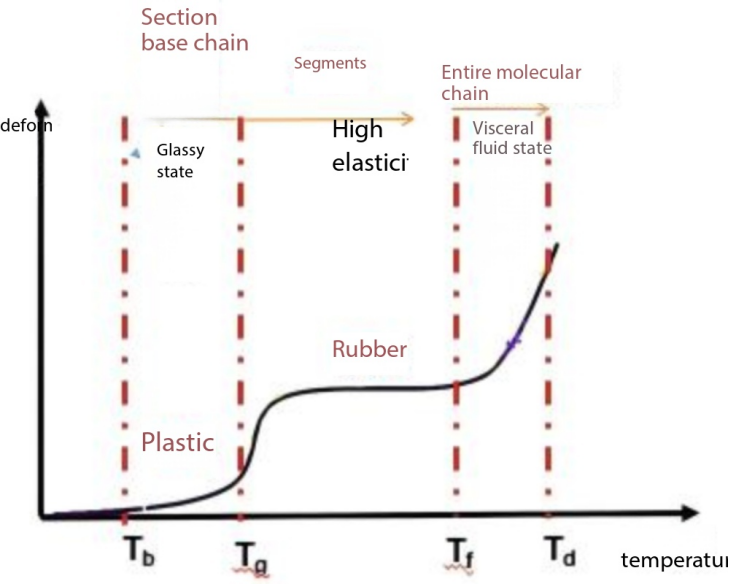
Therefore, temperature control directly governs the physicochemical reaction process of welding. In plastic laser welding, controlling temperature ensures quality; monitoring temperature guarantees reliability. This represents a fundamental consensus in modern high-precision manufacturing.
4. Goal: Power control versus temperature feedback control:
Based on the above, we begin discussing the differences in control methods.
1. Power control: an "open-loop" strategy
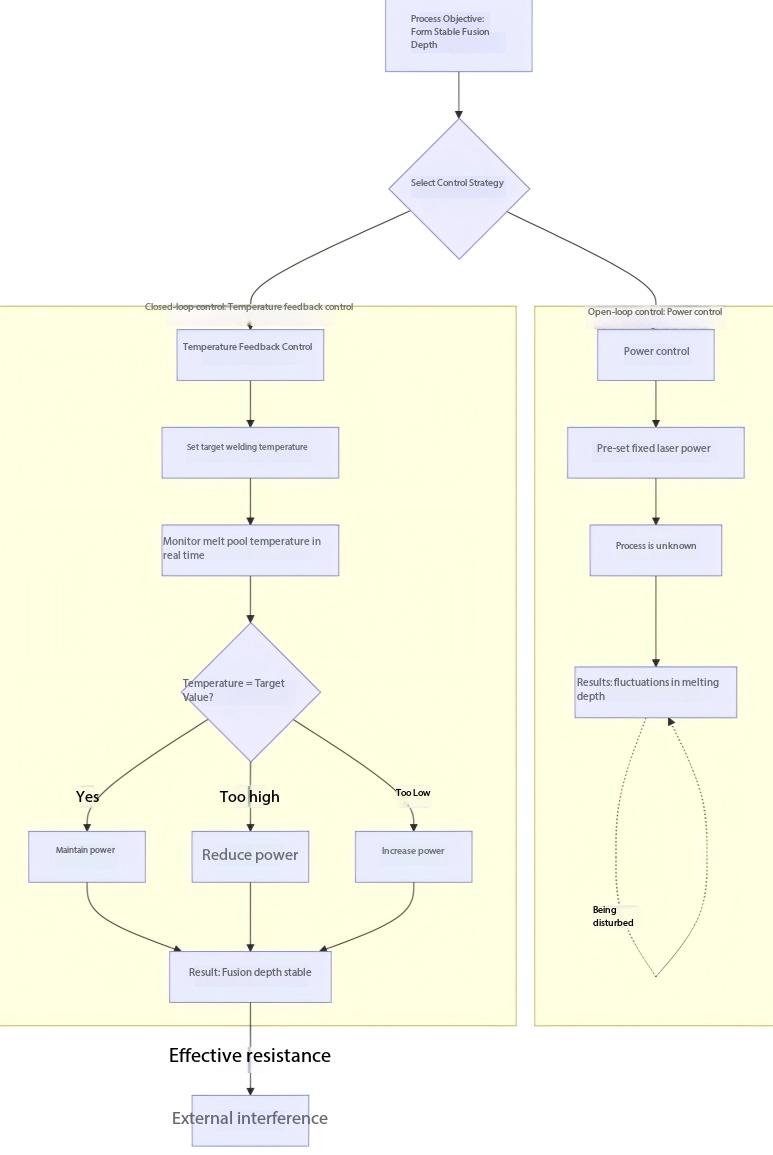
As shown in the path on the left side of the figure, this strategy sets a fixed laser power in advance and assumes that at this power level, the input energy can consistently achieve the desired fusion depth.
· Advantages: Simple system and low cost.
· The fatal drawback: it is "blind". It assumes the system to be perfect—material transmittance/absorbance constant, component contact flawless, and environmental conditions unchanged. In reality, however, any variation directly leads to unstable energy input, resulting in fluctuating fusion depth. Even factors such as laser attenuation during operation or contamination of transparent glass fixtures can cause energy input instability while still causing material softening and depression under pressure; although these may meet the required collapse volume criteria, the degree of plasticization in the weld layer remains unpredictable. (We have previously discussed the composition of collapse volume and the characteristics that an optimal weld surface should possess.)
2. Temperature feedback control: a "closed-loop" or "intelligent" strategy
As shown in the path on the right side of the figure above, the core of this strategy lies in presetting the target welding temperature. The system uses infrared sensors to monitor the temperature of the weld area in real time and compares it with the set value, dynamically adjusting the laser power accordingly.
· Key advantage: Direct control of results. The system dynamically compensates power and monitors whether the temperature at the welding interface remains stable within the optimal material welding window. While monitoring laser power input, it simultaneously tracks the temperature profile of the weld surface.
· Interference resistance: As shown in the figure, this is a continuous closed-loop regulation process. When the system detects any interference causing temperature deviation, it immediately adjusts power in reverse to compensate, ensuring optimal stability of fusion depth.
3: The Microscopic World and Dimensional Changes of Surface Plasticity
Comparison of the micro-world under two control strategies
feature | The microscopic world under power control | The microscopic world under temperature feedback control |
Movement of molecular chains | Energy fluctuations cause the molecular chains to undergo alternating periods of intense and insufficient movement, resulting in varying degrees of diffusion entanglement. | Under constant temperature, the molecular chains continuously and uniformly diffuse and coil at optimal activity. |
Form of the welding layer | Uneven. Some areas may be fully welded (excessive fusion depth), while others may have insufficient welding (incomplete weld). | Uniform and dense. The molecular entanglement density is highly consistent throughout the entire weld area. |
Macroeconomic Performance | The blasting strength data exhibit significant dispersion, posing risks to sealing performance. | It exhibits high and stable explosive strength, along with exceptionally reliable sealing performance. |
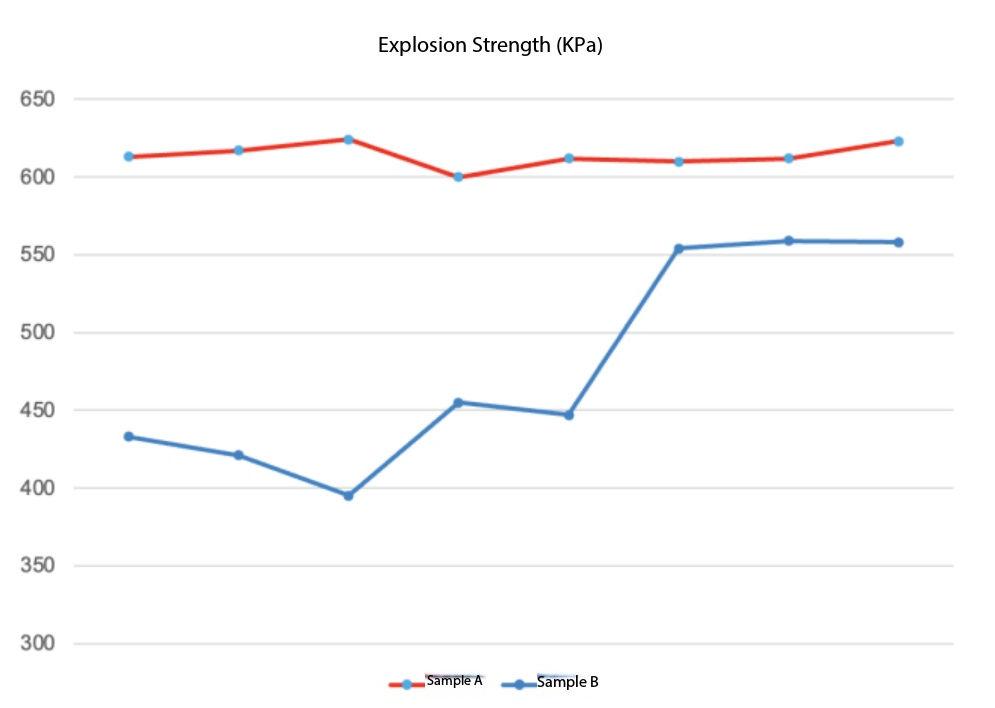
The figure shows the ultimate blast strength of samples under two different process parameter controls from the previous sampling phase. It is evident that although Sample B also achieves a blast strength exceeding 0.4 MPa, its ultimate blast strength values exhibit significant variability.
Sample A: Laser temperature-controlled closed-loop system with collapse amount feedback
Sample B: Fixed laser power + collapse amount feedback
Conclusion
· Power control is a process that regulates input energy to achieve an ideal outcome (melting depth). It is cost-effective but fragile, making it suitable for applications with low requirements.
· Temperature feedback control directly regulates the outcome (interface temperature) to enable the system to automatically optimize the process (power). By compensating all fluctuations in real time, it directly safeguards the microscopic physicochemical processes required to achieve a qualified melting depth.
Conclusion: In fields with stringent quality requirements such as automotive electronics, temperature feedback control is essential for achieving high yield, high reliability, and traceability, as it fundamentally ensures the consistency of the weld microstructure, thereby determining the superior and stable macroscopic performance of the product.
 Home
Home Products
 Telephone
 Message


