



I. The Critical Factor: Temperature's Determinative Role in Plastic Laser Welding
Temperature is not merely a simple process parameter; rather, it serves as the critical link between laser energy and welding outcomes. Its importance manifests in several key aspects:
1. The "golden window" of temperature: the narrow range between melting and degradation
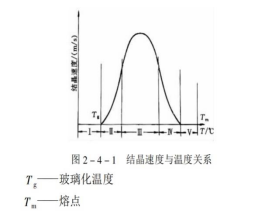
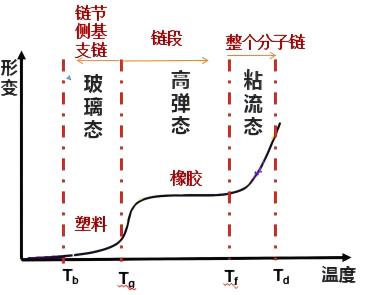
Each plastic material has its specific melting temperature range (Tm) and thermal degradation temperature (Td). Ideal welding requires the interface temperature to be precisely controlled within a narrow "process window" above Tm but well below Td.
· Insufficient temperature (<Tm): The material fails to melt completely, preventing molecular chains from diffusing and interwinding properly, resulting in "incomplete welding" or "poor penetration," with both weld strength and airtightness failing to meet requirements.
· Excessive temperature (≥ Td): The polymer chains in the plastic break, leading to bubble formation, carbonization, discoloration, and release of toxic gases. This results in brittle welds, the formation of leakage pathways, and simultaneous deterioration of both product appearance and functionality.
2. Temperature is the ultimate manifestation of energy conversion
Parameters such as laser power, welding speed, and spot size are ultimately designed to deliver precisely the appropriate "linear energy" to the weld interface, which is then manifested as temperature. However, numerous variables can interfere with this conversion process:
· Material variations: Materials from different batches and suppliers exhibit minor differences in absorbance, specific heat capacity, and thermal conductivity.
· Environmental fluctuations: Environmental temperature and the thermal capacity of fixtures may remove or introduce additional heat.
· Geometric features: Variations in product thickness, corners, and other geometric characteristics can lead to uneven heat accumulation.
These interfering factors make it difficult to maintain stable temperatures within the "golden window" for every workpiece and each weld seam path using fixed laser parameters (e.g., constant power).
3. Temperature field uniformity determines the consistency of weld quality
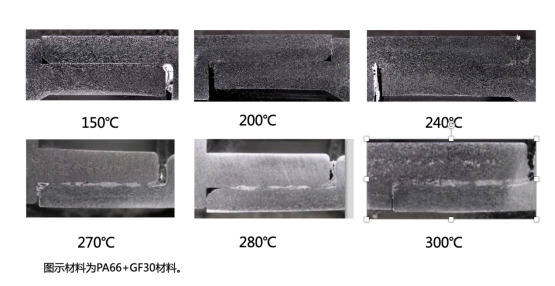
A high-quality weld seam must exhibit uniform melt depth and strength throughout its entire length and width. This requires the temperature field to remain highly homogeneous both temporally and spatially. Any localized temperature deficiency or excess will create stress concentration points or weak links, which may lead to long-term failure.
Illustration of weld cross-sections for the same material under different temperature conditions during welding processes
II. From "Open Loop" to "Closed Loop": The Application Advantages of Temperature Control Feedback Technology
Traditional laser welding employs "open-loop" control, which involves presetting a set of parameters (power, speed, etc.) with the aim of producing qualified products. In contrast, constant-temperature feedback technology introduces "closed-loop" control, whose core principle is to monitor the temperature in the weld zone in real time, compare it with the set target value, and dynamically adjust the laser output power using intelligent algorithms to maintain the temperature consistently near the target value.
This closed-loop control system offers revolutionary advantages:
1. Compensates for fluctuations to achieve extremely high process stability
· Compensation for material variations: Even with minor fluctuations in the light transmittance or absorbance of the supplied material, the system can dynamically adjust power output in real time to maintain optimal energy delivery at the interface, ensuring stable temperature. This reduces overly stringent requirements for raw materials.
· Compensation for external disturbances: Long-term drift factors such as fixture temperature rise and slight laser power attenuation are automatically compensated by the system, ensuring consistent product quality from production initiation to eight hours post-production.
2. Improve yield rates, particularly the welding performance of complex welds
· When welding workpieces with varying thicknesses or geometries (e.g., heat tends to accumulate at corners while dissipating easily in thin walls), the system intelligently reduces power at corners and increases it in thin areas, ensuring uniform fusion depth along the entire path and significantly improving the first-pass pass rate of complex components.
3. Eliminate reliance on manual experience and achieve high-quality welding with a one-click operation
· The core of process optimization has been simplified from "adjusting dozens of complex power-speed curves" to "setting an optimal temperature value," significantly reducing the complexity of process debugging and the reliance on operator expertise, thereby facilitating process transfer and replication.
4. Establish a complete data traceability chain
· The constant temperature feedback system records the actual temperature curve and power adjustment curve for each welding process, creating a unique "welding health report" for each product and enabling full lifecycle quality data traceability. In case of issues, it allows rapid determination of whether the problem stems from temperature abnormalities or other causes.
The constant temperature feedback system is not merely a control tool, but also a powerful instrument for process monitoring and diagnosis. It transforms numerous hidden defects inherent in traditional welding processes into clearly identifiable electronic signals.
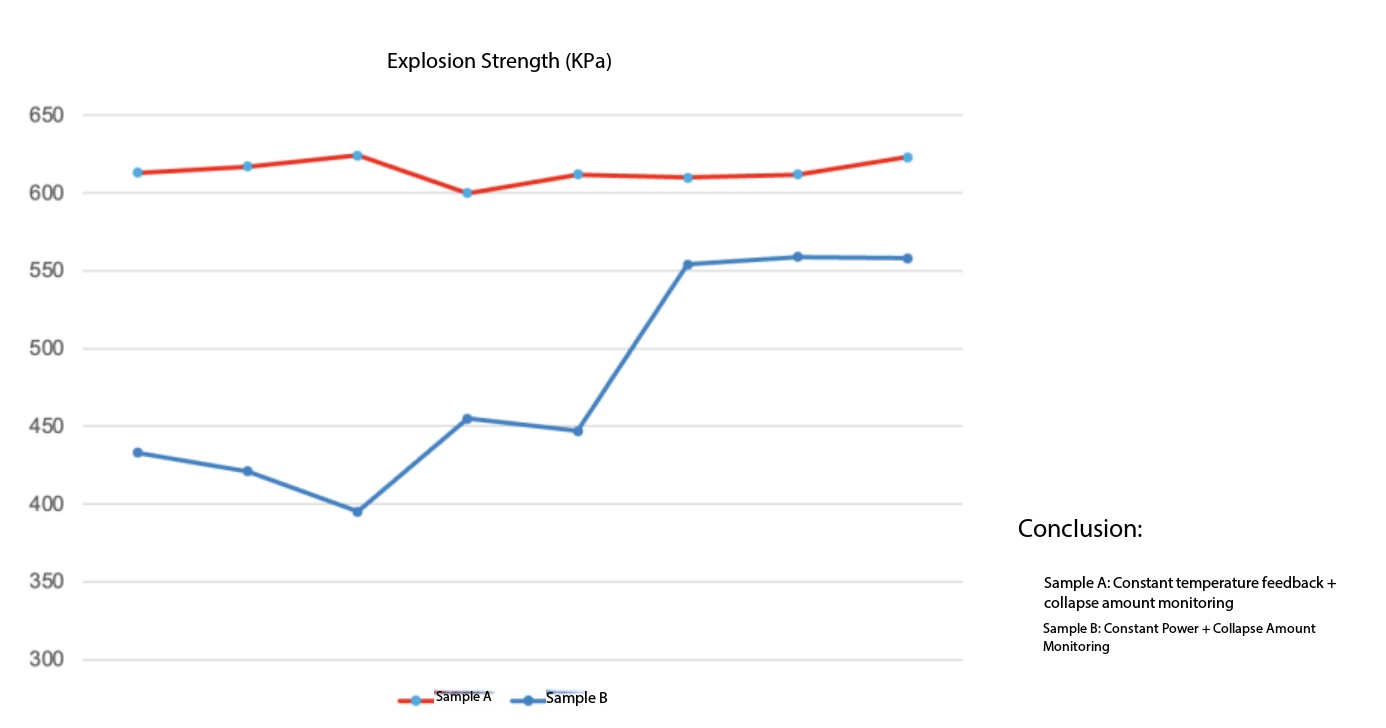
Test data on the welding strength of PBT material actuators from a major manufacturer
Another function of the constant temperature system
Keen Eye: How the Constant Temperature Feedback Interface Identifies Welding Abnormalities
Building on the previous discussion, when anomalies such as glass fiber clustering or weld surface contaminants occur in the upper material layer, the constant-temperature feedback system accurately identifies and records these issues using its unique "language" —real-time temperature-power curves.
In constant temperature control mode, the system's primary objective is to maintain the preset welding temperature. Any factor that disrupts this goal triggers a "stress response" in the system controller, which is clearly reflected in the monitoring curve.
1. Identification of "glass fiber agglomeration"
· Mechanism of malfunction: The glass fiber aggregates act like a "thermal insulating shield" and "light barrier," strongly scattering laser light and obstructing energy transmission downward. To maintain the set temperature, the system must operate at maximum intensity.
· Characteristic signals on the constant temperature feedback interface:
o The power curve rises sharply: When the system detects a temperature exceeding the set threshold, it continuously and significantly reduces the laser output power in an attempt to overcome this critical point. On the power-time curve, a sudden, sharp peak is observed.
o The temperature curve exhibits severe fluctuations or a sustained decline: Although the power output has been reduced to a very low level, actual measured temperatures may remain below the set value or show significant variations due to substantial energy obstruction. This divergence between "extremely high power" and "low temperature" is a hallmark characteristic of glass fiber aggregation.
o Final outcome: If the clustering is mild, the system may barely overcome it but will record a power spike. If clustering is severe, the system cannot reach the target temperature even after increasing power to its limit, triggering an overload alarm, automatically stopping welding, and marking the product as defective.
2. Identification of "surface stains"
· Mechanism of anomaly: Organic contaminants such as oil stains and fingerprint marks undergo carbonization at high temperatures. The absorption rate of carbon by laser radiation is significantly higher than that of the plastic itself.
· Characteristic signals on the constant temperature feedback interface:
o The temperature curve exhibits a sudden surge: upon carbonation of the pollutant, it instantly absorbs a substantial amount of laser energy, causing a rapid localized temperature increase that far exceeds the set threshold.
o The power curve drops sharply or even reaches zero: when the system detects excessively high temperatures, it immediately and significantly reduces laser power, or even temporarily shuts off the laser, in an attempt to cool the material.
o Final result: On the curve, you will observe a "temperature spike" accompanied by a "power peak." This typically indicates surface burn, bubbles, or carbonization on the material. The system will record this abnormal event.
Comparison and Diagnosis:
An excellent temperature-controlled feedback system software interface simultaneously displays the set temperature curve, actual temperature curve, and real-time power curve. By analyzing the shapes of these curves, operators or quality engineers can perform precise diagnostics.
Exception Type | Characteristics of the temperature curve | Power Curve Characteristics | physical cause |
Fiberglass aggregation | Below the set value with fluctuations or stability | Suddenly surged to a high level | Energy is blocked and cannot be transmitted |
Surface stains | It suddenly soared far beyond the set value. | Sudden sharp decline | Energy is excessively absorbed by the surface layer. |
normal weld | Steady with slight fluctuations around the set value | Adjust based on path smoothing | Energy input and demand balance |
The significant advantage from "identification" to "management and control"
This precise identification capability has revolutionized quality management:
1. 100% real-time process monitoring and automatic interception: During welding, the "physiological parameters" (temperature, power) of each workpiece are monitored in real time. Upon detection of any abnormal trends, the system can immediately trigger an alarm or halt operation to prevent the production of defective products. This achieves genuine in-process control rather than post-event inspection.
2. Accurate tracing of defect origins: Upon identifying a nonconforming product, extensive destructive analysis is no longer required. By retrieving the product's welding curve, one can preliminarily determine whether the issue lies within the material (e.g., glass fiber aggregation) or in surface cleanliness (e.g., contaminants), thereby guiding the responsible departments (mold injection or assembly) to implement targeted improvements.
3. Optimization and refinement of the process window: By analyzing extensive normal and abnormal data, welding parameters can be retroactively optimized to establish more appropriate power thresholds and temperature tolerances, thereby enhancing process robustness.
Conclusion
Constant temperature feedback technology equips plastic laser welding with both "eyes" and a "brain." It not only dynamically adjusts parameters to ensure quality but also transforms physical defects such as glass fiber clustering and surface contaminants into digital, quantifiable anomaly signals. This makes the production process transparent, traceable, and diagnosable, significantly enhancing quality reliability and consistency—particularly in high-defect-free requirements sectors like automotive electronics, where this technology has become an indispensable foundation for quality control. In plastic laser welding, temperature control capability directly reflects final product quality standards. By transforming temperature—a critical process parameter—from a passive outcome into an active control objective, constant temperature feedback marks its evolution from an "artistic" approach to precise scientific methodology. For industries pursuing zero defects (e.g., automotive electronics and medical devices), investing in welding systems with constant temperature feedback functionality is no longer merely a technological upgrade but a necessity for ensuring product reliability, improving production efficiency, and achieving digital manufacturing. It serves as a powerful tool for building a competitive quality advantage in fierce market competition.
 Home
Home Products
 Telephone
 Message


