



In engineering practice, welding issues are often reduced to questions of "whether parameters are appropriate" or "whether equipment is advanced," yet numerous failure cases demonstrate that the root problems typically lie not in the manufacturing process but are inherent from the design phase. This paper endeavors to examine the fundamental physical properties of materials, systematically elucidate the true mechanisms of welding, identify which materials are truly weldable and which can only achieve functional connectivity, and propose a welding methodology tailored for the design stage.
1. Reinterpret welding: it is not merely "adhesion," but rather the restructuring of interface materials
Intuitively, welding seems to simply mean "connecting two objects together."
From the perspective of materials science, however, whether it involves metal welding or thermoplastic plastic welding, their fundamental nature is the same:
Through controlled energy input, the material structure at the interface is disrupted and reorganized, forming a new, continuous interface region.
In an ideal scenario, this area should have:
· The interface is indistinguishable
· The mechanical properties are similar to those of the base material.
· Continuity in electricity and thermodynamics
It should be emphasized that in actual engineering applications, welds identical to the base material are extremely rare.
Most welding interfaces are essentially transition zones with precisely controlled properties.
Key Concepts in Engineering
Welding is not about whether the joint is properly joined, but rather about whether the interface performance has been correctly designed.
Comparative diagram of the three connection methods
· Left: Bonding (clear interface)
· Ideal welding (interface disappearance)
· Right: Engineering welding (performance transition layer)



II. Molecular-level interpenetration: The theoretical upper limit of traditional welding strength
In the welding of thermoplastics (ultrasonic welding, hot plate welding, laser transmission welding), there are well-defined physical prerequisites for successful welding:
· Amorphous materials: Temperature ≥ Glass transition temperature (Tg)
· Semi-crystalline materials: Temperature ≥ melting point Tm
When the material enters a diffusive state, polymer chain segments undergo molecular diffusion and chain entanglement on both sides of the interface.
It means that :
· The welding time increases, and the strength improves, but the benefits diminish.
· Temperature has an exponential effect on welding performance.
A very important point is:
The upper limit of weld strength depends on the entanglement density of chain segments, rather than on how deeply the material is melted or how intact the weld appearance appears.
[Figure 2 | Understanding Type]
State diagram of polymer chain segments
· Not spread (weak soldering)
· Partial diffusion (functional welding)
·  Highly intertwined (structural weld)
III. Metal Welding: The Coexistence of Metallurgical Continuity and Engineering Requirements
The bonding mechanism of metal welding primarily stems from metallurgical processes, including:
· Lattice rearrangement and recrystallization
· Grain growth or refinement
· Formation of the precipitate phase
· Metallurgical diffusion (particularly pronounced in heterogeneous metals)
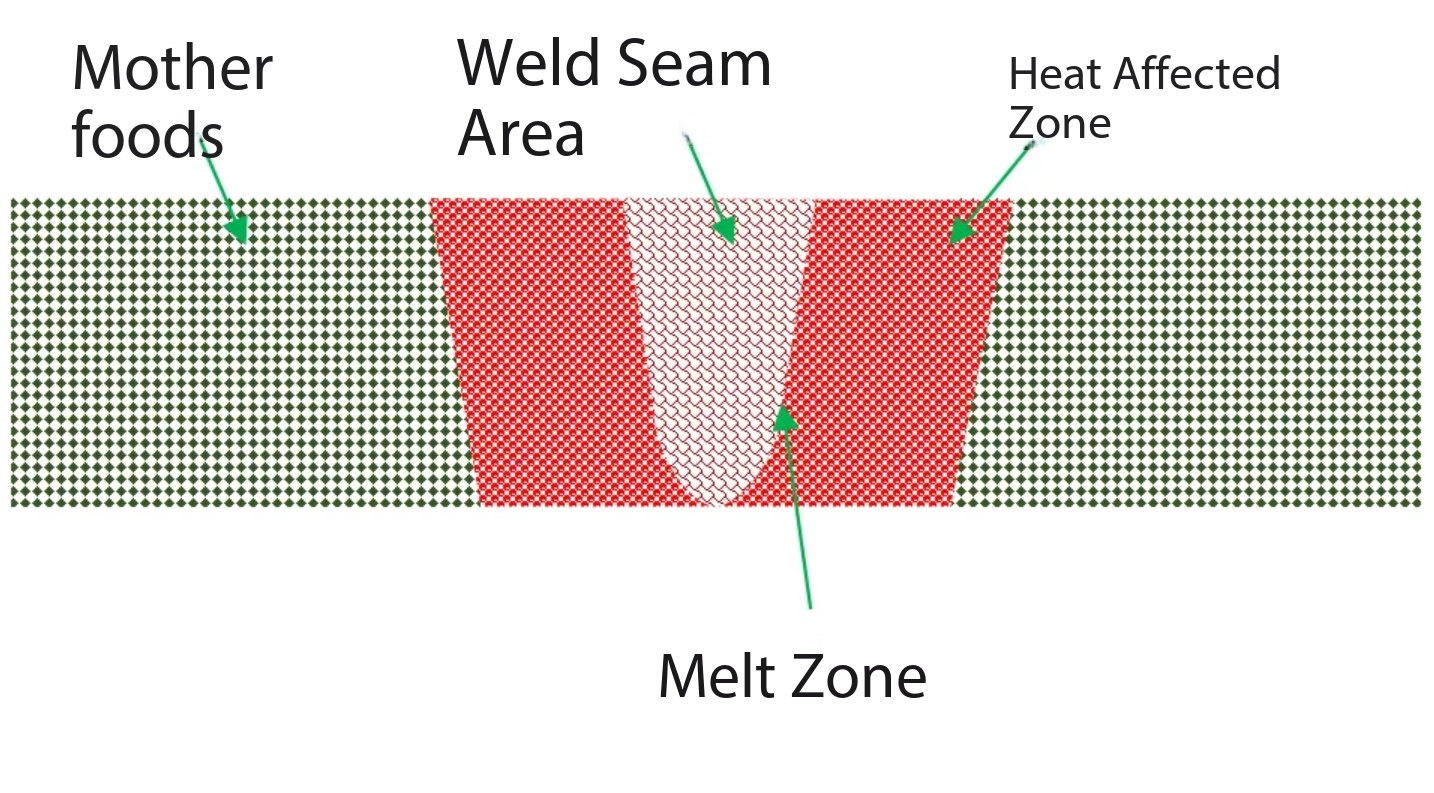
After welding, three regions are typically formed:
· weld metal area (WZ)
· fusion area (FZ)
· Heat Affected Zone (HAZ)
In engineering practice, HAZ often refers to:
· Area of decreased intensity
· Crack initiation zone
· Corrosion-sensitive area
Practical Conclusion
Metal welding is not about "the better the fusion, the better"; rather, it requires striking a balance between metallurgical continuity and controlled microstructure.
[Figure 3 | Structural-Cognitive Type]
Schematic diagram of metal welding cross-section zoning (WZ/FZ/HAZ)
IV. Advancement in Welding Understanding: From "Material Integration" to "Functional Achievement"
As product structures become increasingly complex, the engineering community's understanding of welding is evolving:
The objective of welding is no longer whether materials are completely fused, but whether the designed functionality can be reliably achieved under specified service conditions and lifespan requirements.
This has directly spurred the widespread adoption of two new approaches.
1. Intermediate Layer and Interface Engineering
By introducing:
· Polymer copolymer film
· Modified adhesive layer
· Metal brazing materials
· Conductive filler
Establishing a performance gradient between incompatible materials to achieve transitions in mechanical, electrical, or thermal properties.
[Figure 4 | Interface Engineering]
A / Intermediate Layer / B Schematic diagram of the gradient interface

2. Microstructural welding: Welding morphology, riveting characteristics (key point)
In the following scenarios:
· Giant Pulse Laser Welding of Copper Foil–Aluminum Foil Composites
· Metal-plastic laser cladding welding
· Thermal pressing or ultrasonic welding of heterogeneous plastics
Welding does not rely on molecular interpenetration or metallurgical continuity, but rather through:
· Local instantaneous melting
· Collapsing and Reflow
· Rapid solidification
A micro-scale physical interlocking structure is formed at the interface.
Its strength originates from:
· The structure provides geometric locking for the load path.
· The shear and pull resistance of the microstructure
When the material cannot be welded, the structure must bear the load on its behalf.
Physical nesting is not a compromise, but rather a well-defined and predictable engineering approach.
[Figure 5 | Essential for Key Points]
The formation process of microstructures during copper-aluminum welding using high-power pulsed lasers
· transient melting
· back-flow
· Re-solidify the "nail-like structure".
· Shear Force Path
V. Material boundaries in plastic welding: Which materials can be welded, and which can only achieve "functional connection"?
PC + PBT
· Amorphous/Hemicrystalline combination
· The effective welding window is extremely narrow.
· The molecular interpenetration is extremely weak.
· The strength primarily originates from structural interlocking.
· Shear strength: approximately 5–15 MPa
�� Suitable for sealing and functional welding; not recommended as the primary load-bearing structure.
PMMA + PC
· Amorphous / Amorphous Composite
· The segment has undergone thorough diffusion.
· The weld strength can reach 60–80% of that of the base material.
· The shear strength can reach 25–40 MPa.
Can be used for structural weld design.
[Figure 6 | Material Comparison]
Comparison diagram of the welding window for amorphous and semi-crystalline materials
VI. Practical Limitations of Metal Welding Between Different Metals: A Case Study of Copper and Aluminum
In Cu–Al welding, the key engineering consideration is not whether the weld is successfully formed, but rather:
· Whether the formation of intermetallic compounds (IMCs) is controlled
· Whether to avoid the continuousization of brittle phases
The IMC thickness is typically required to be kept below 10 μm, which is the fundamental reason why brazing and pulsed laser welding are widely adopted.
[Figure 7 | Failure Perception]
Graphical representation of the relationship between IMC thickness and joint brittleness
VII. Welding Methodology for the Design Side (Key Perspectives of the Full Text)
The most common—and also most fatal—path in engineering is:
First design the structure → Then determine the welding process → Finally, a compromise was forced.
The correct logic should be:
Material Physics → Interface Mechanisms → Process Window → Structural Design
The design phase must clearly define:
· Should molecular-level welding be pursued?
· Should functional welding be accepted?
· Do you need an intermediate layer or structural compensation?
epilogue
The essence of welding technology lies in the thermodynamic restructuring of material interfaces. Truly mature welding design hinges not on technological sophistication, but on respect for materials' physical boundaries. In the future, driven by AI-powered process optimization and advancements in interface engineering materials and micro/nano-manufacturing technologies, welding will evolve from parameter tuning to interface performance design. Understanding the fundamental principles underlying materials remains an indispensable cornerstone in the evolution of welding technology.
 Home
Home Products
 Telephone
 Message


