



In automotive thermal management systems, the welding quality of nylon pipes and fittings is often summarized in three words:
"Leakage or not." However, what truly determines the vehicle's reliability over 8–12 years is not its current sealing performance, but a variable that is predetermined at the moment of welding: whether the hydrolysis-resistant system has been compromised during manufacturing.
1. Automotive-grade nylon piping: Hydrolysis resistance is not merely a "plus point" but the fundamental determinant of service life.
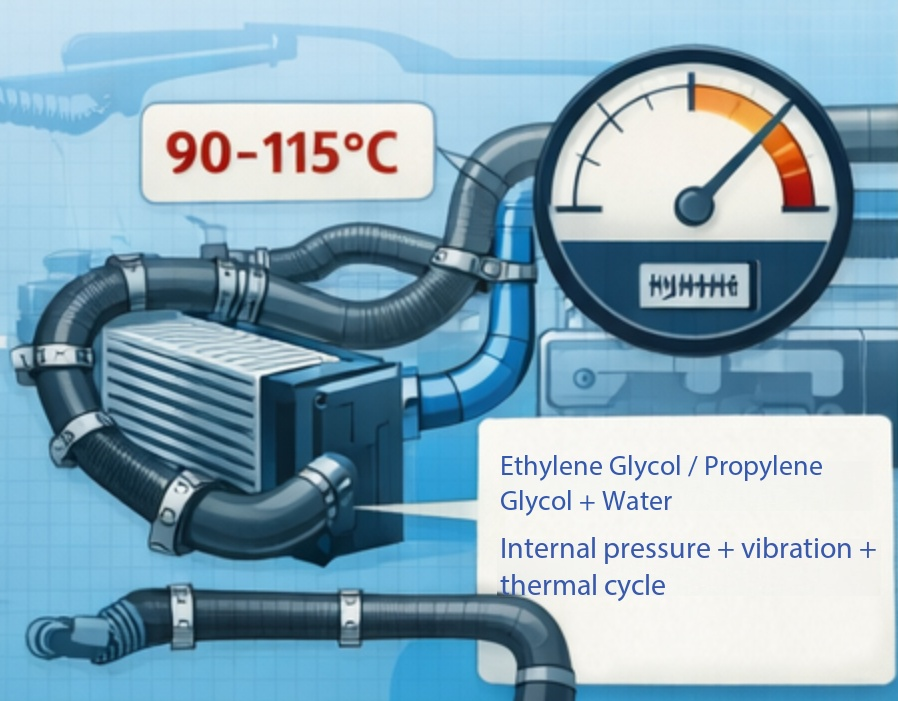
In cooling circuits/heat pump systems, nylon piping operates under typical automotive conditions over extended periods:
· Temperature: 90–115 °C (up to 120 °C in some areas)
· Media: ethylene glycol/propylene glycol + water
· stress: internal pressure + vibration + thermal cycling
In this environment, the amide bonds (–CONH–) within nylon (PA) molecular chains inevitably undergo hydrolytic cleavage.
The conclusion is unequivocal: hydrolysis resistance modification is a mandatory requirement for automotive-grade nylon, not an optional performance feature.
The actual material composition of automotive nylon tubes
project | The reasonable scope of engineering considerations |
Common Materials | PA66-GF25/GF30, PA12 (for certain low-temperature applications) |
Water-resistant agent | Polycarbodiimide (PCDI) |
additive amount | 0.3–1.5 wt% |
Dispersal Scale | < 3–5 μm |
key role | Capture the –COOH terminus to block the hydrolysis chain reaction |
pay attention to :
Hydrolysis resistance is not determined solely by whether a additive is added, but rather by its dispersion, stability, and effectiveness after welding.
Figure 1: Schematic diagram of the operating environment for automotive nylon pipelines
The verification logic that truly matters
Automotive-grade validation has never been about simply meeting basic tensile strength requirements.
· Immersed in coolant at 120 °C for 1000 hours
· Tensile strength retention rate ≥ 65–70%
· No through cracks / No leakage in the welding area
This is a comprehensive evaluation of the material, manufacturing process, and weld area.
II. Welding overheating: What is truly overlooked is not the nylon material, but rather the hydrolysis-resistant system.
The core issue in laser welding has never been whether the weld can be formed, but rather:
Temperature peak value × residence time × oxygen environment = "silent death" of the hydrolysis-resistant system
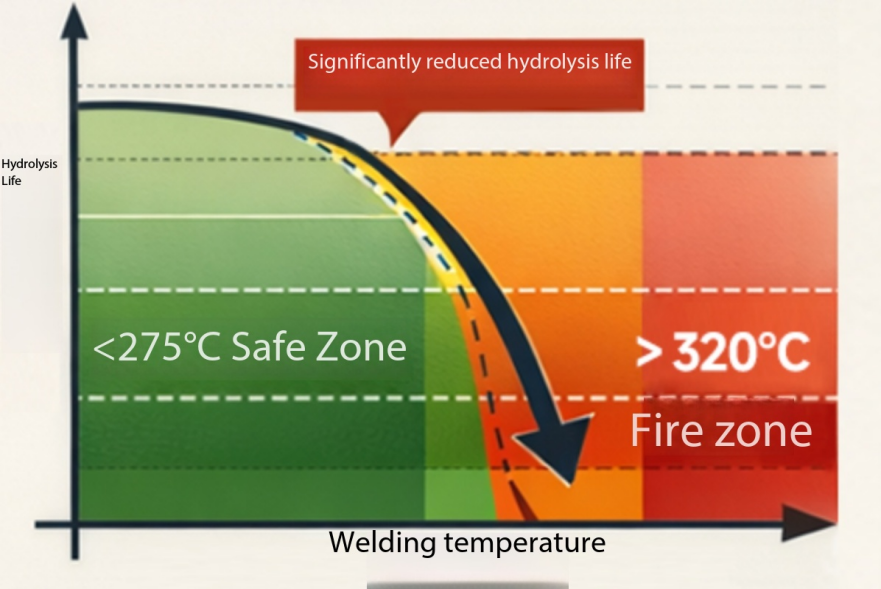
1. The actual engineering range for welding temperatures
region | Engineering Facts |
PA66 Melting Zone | 255–265 ℃ |
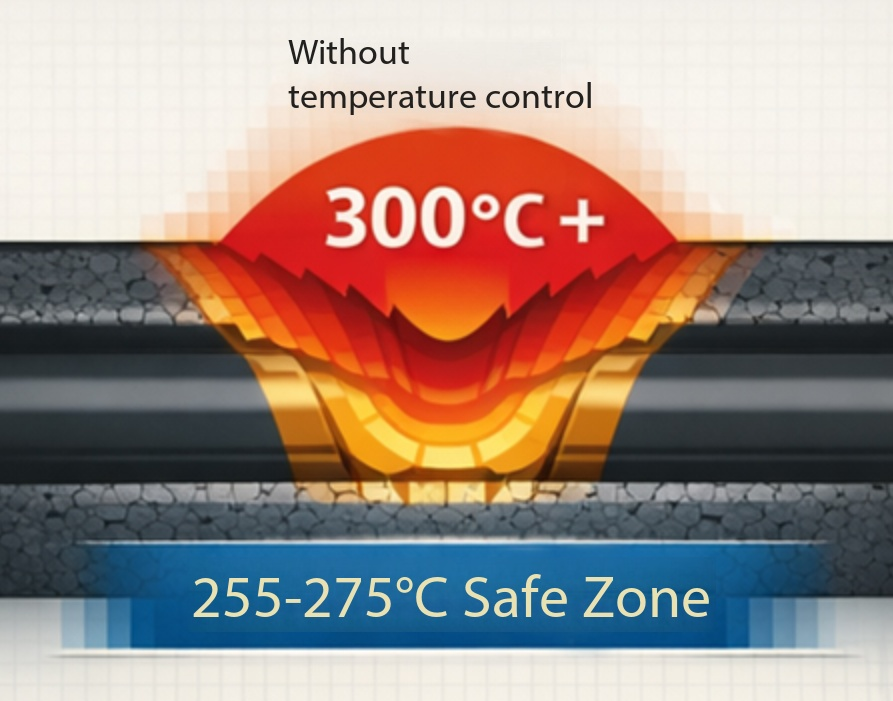
Safe Welding Window | 255–275 ℃ |
PCDI Stability Upper Limit | ≈ 270–280 °C (short-term) |
high risk area | ≥ 290–300 ℃ |
Disaster Area | ≥ 320 °C (destruction within seconds) |
⚠ More insidiously, the heat-affected zone of laser welding is merely 50–300 μm wide, with overheating occurring exclusively in the weld fusion zone. No macroscopic abnormalities are observed, and short-term sealing tests fail to detect any issues; however, hydrolytic resistance is locally compromised. Instant temperatures exceeding 300 °C during laser welding are not uncommon, particularly in the following scenarios:
· The wall of the tube is relatively thin.
· The absorption layer is too thick.
· Energy regulation relies on experience.
· The laser energy is excessively concentrated, and there are no monitoring measures in place.
Figure 2: Actual temperature distribution profile in the laser welding fusion zone
III. Anti-hydrolysis agents are not "gone," but rather "have become ineffective."
This is the part of the entire issue that is most prone to misinterpretation.
1. Where does the hydrolysis resistance of PCDI come from?
From its core functional groups:
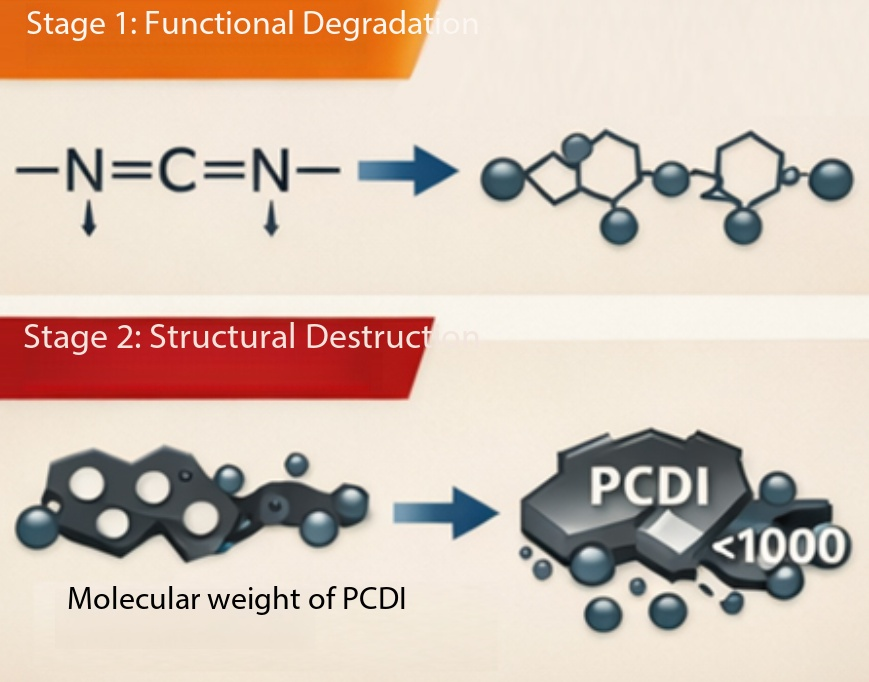
–N=C=N– (carbodiimide)
Its mission is singular:
Capture the –COOH carboxyl groups generated by nylon hydrolysis
2 The actual failure process under welding overtemperature conditions
Stage 1 | Functional degradation (≈ 270–290 °C)
· The functional group is attacked by thermal oxygen radicals.
· The hydrolysis-resistant capacity is rapidly depleted.
· The appearance is completely normal.
Stage 2 | Structural Failure (≥ 300 °C)
· PCDI main chain has broken
· Molecular weight: 3000–8000 → <1000
· Effective hydrolysis inhibitor <10–20%
Key Cognitive Correction:
It's not that PCDI no longer exists, but that it can no longer capture the COOH terminus.
Figure 3: Schematic diagram of the thermal degradation pathway of PCDI functional groups
IV. What is truly fatal is the triple synergistic effect
Overheating during welding is not a problem per se, but rather an amplifier of issues.
1. Thermal degradation of the nylon matrix
· Molecular chain cleavage
· The density of –COOH terminal groups has surged dramatically.
· The starting point for hydrolysis increases significantly.
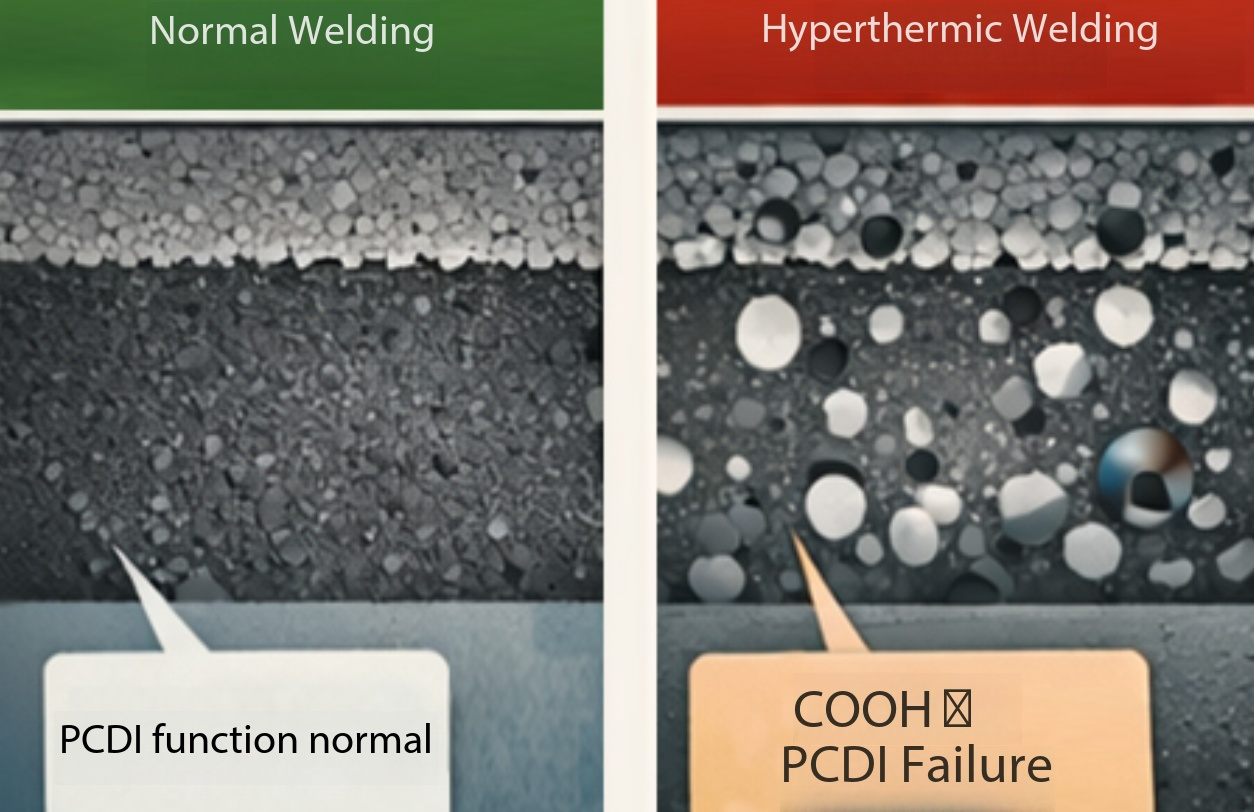
The microporous structure is formed irreversibly.
· Water content + high temperature → Microbubbles
· The welding area forms a closed pore with a diameter of 10–100 μm.
· Coolant retention forms a "local reaction chamber".
The 3-hydrolysis-resistant system has failed.
· The PCDI, which was supposed to provide a safety net, has become non-functional.
· The hydrolysis reaction is no longer controlled.
Engineering-grade conclusion: The hydrolysis rate in the welded fusion zone is 5–8 times that of conventional pipe materials.
Figure 4: Comparison of microstructure between normal welding and overheated welding
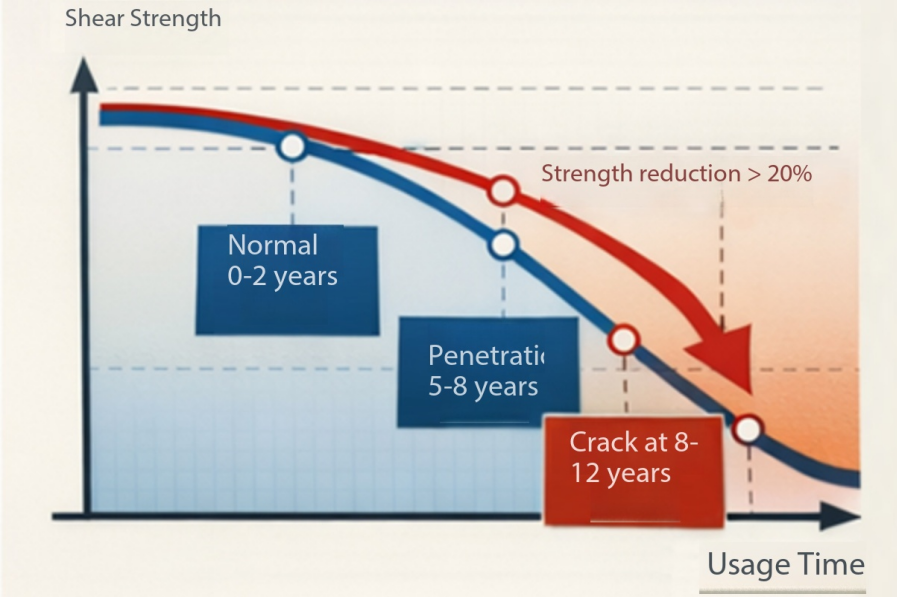
V. Why have these issues all emerged collectively after the product's warranty period has expired?
Usage Stage | Typical manifestations |
0–2 years | Appearance, sealing, and explosion testing are all satisfactory |
2–5 years | The shear strength in the welding zone decreases by 15–30%. |
5–8 years | Microleakage, leukoderma, localized softening |
8–12 years | Permeating weld crack with systematic leakage |
Figure 5: Time-dependent strength attenuation curve of the welding area
VI. Truly effective prevention and control measures never rely on merely "conducting one additional test".
✅ Primary variable: Temperature
· Infrared temperature measurement / Closed-loop system for the molten pool
· Control Target: 255–275 °C
· Accuracy: ±2–3 °C is sufficient
✅ Energy Density (قابل for implementation)
· Recommendation: 25–40 J/cm²
· Avoid single-point dwellings and prevent heat accumulation.
· Real-time monitoring of laser power.
✅ Water content control (severely underestimated)
· Pre-weld drying: 80–90 °C for 4–6 hours
· Moisture content target: <0.1 wt%
Figure 6: Schematic diagram illustrating the relationship between welding temperature and hydrolysis resistance lifespan
epilogue
The true quality of nylon pipeline welding does not lie in its current leak-proof performance, but rather in whether the weld seam remains as durable as the base material after the warranty period. Failure of hydrolysis resistance is a typical silent defect.
· disappearance
· Cannot be measured
· Once it occurs, it represents a systemic failure.
Temperature closed-loop control during welding is not a cost issue, but rather the most fundamental respect for material properties.
 Home
Home Products
 Telephone
 Message


