



In metal laser welding, the "keyhole effect" indeed constitutes the core issue underlying all deep fusion welding problems. Recent studies have demonstrated that applying an external magnetic field can modulate melt pool flow and the dynamic evolution of keyholes, thereby significantly reducing porosity issues.
I. Fundamental Differences Between the Two Welding Modes
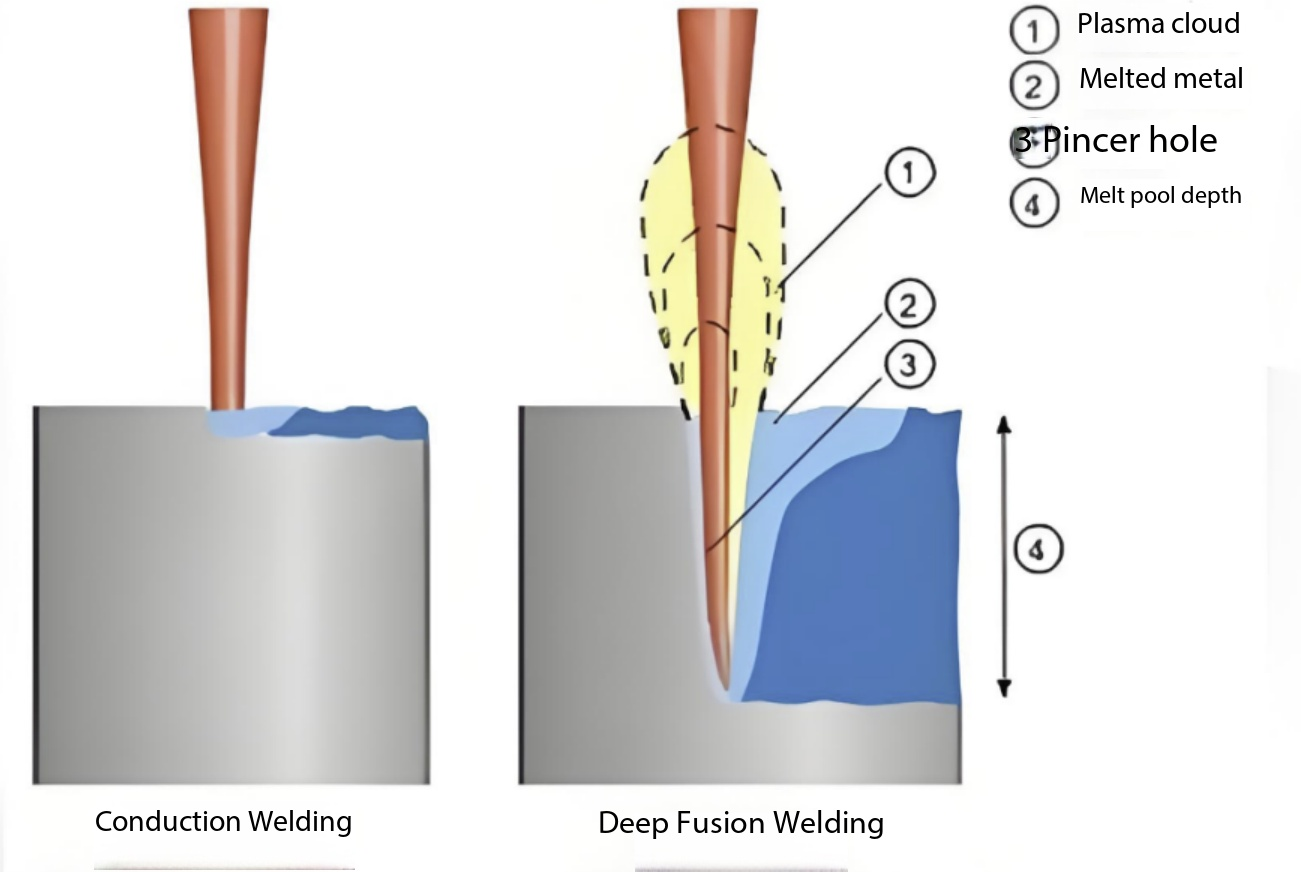
1. Thermal conduction welding: Energy diffuses at the surface
Illustration description: On the left, a laser beam is shining on a metal surface; on the right, a heat map illustrates how heat spreads outward from the irradiation point, forming a broad, shallow molten pool contour.
At low power densities (typically below 10⁶ W/cm²), laser energy is primarily absorbed at the material surface and subsequently diffused inward via thermal conduction. Characteristic features include a weld width-to-depth ratio typically less than 1.5 and relative process stability.
2. Hole welding (deep fusion welding): Energy is injected into the material to create holes.
When the laser power density exceeds the material's vaporization threshold (typically requiring values above 10⁶ W/cm²), the material undergoes rapid localized vaporization, forming cavities filled with metallic vapor. Recent studies have demonstrated via high-speed X-ray imaging that eddy-induced protrusions on the posterior lockhole wall play a critical role in inducing lockhole instability.
II. Why is the "keyhole effect" considered decisive for welding quality?
1. Secure the keyhole → Ensure high-quality welds
The dynamic parameters of the pore (depth and width) and laser energy absorption exhibit random fluctuations around the equilibrium state during the fluctuation phase, with the pore depth following a left-skewed Gaussian distribution. When the pore is stable, energy input is continuous and melt pool flow is orderly.
Two-hole instability → Root cause of the defect
Studies have shown that when the ratio of melt pool depth to width exceeds 1.5, the stability of the crater significantly decreases, with the collapse frequency increasing to 5–8 times per second, greatly predisposing it to lockhole-type porosity formation. Research further reveals that craters exhibit periodic "narrowing-fracture" behavior during fluctuations in laser power or abrupt changes in scanning speed.
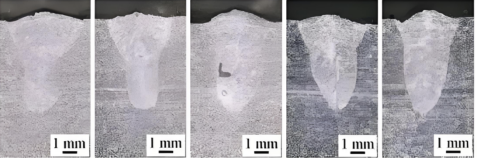
The schematic shows a metallographic cross-section, clearly illustrating the shape of the molten pool.
III. How is the spoon hole formed?
1) Surface heating 2) Local vaporization 3) Formation of vapor pressure 4) Establishment of cavity 5) Multiple laser reflections
The formation of pinholes depends on whether the power density exceeds the material's vaporization threshold. During deep fusion laser welding, pinholes serve as a key characteristic; their instability can lead to welding defects. Studies indicate that both the overall laser absorption rate and that of the front and rear walls follow approximately normal distributions, with fluctuations in the rear wall absorption rate contributing more significantly to total absorption variability.
IV. The most frequently overlooked issue – laser power fluctuations.
In practical engineering applications, when a system operates within the critical region between thermal conduction welding and keyhole welding, it results in intermittent keyhole formation and fluctuating weld depths. During laser welding, metals undergo instantaneous melting followed by extremely rapid cooling, enabling rapid solidification and dynamic recrystallization, which leads to the formation of a significantly refined non-equilibrium metallographic structure. Therefore, during laser welding—particularly when requiring a high depth-to-width ratio—the stability of laser output power is paramount. Notably, this required power stability demands a response on the microsecond scale; conventional average power measurements using thermopile power meters are insufficient for such precision detection.
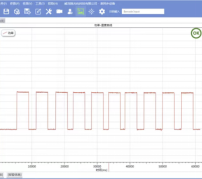

The figure shows the fluctuations in laser power of two high-power continuous fiber lasers under real-time monitoring, with a light emission duration of 50 ms.
V. Key Control Approaches in Engineering
✔ Define welding mode
· Thin plates/external components → Thermal conductive welding (power density <10⁶ W/cm²)
· Structural strength/sealing performance → Deep fusion welding (power density> 10⁶ W/cm²)
✔ Avoid operating in the critical zone
Do not operate for extended periods in areas near the spoon hole formation but unstable. The focus should be positioned 30%–70% below the workpiece surface at the melting depth to achieve optimal depth-to-width ratio.
✔ Control keyhole stability (deep fusion welding)
Recent studies demonstrate that applying a transverse magnetic field can alter the net flow vortex by inducing secondary thermal electromagnetic fluid dynamics flows, thereby suppressing keyhole instability. Additionally, process optimization techniques such as dual-spot technology are also effective in addressing small-hole stability issues.
VI. Engineering Recommendations and Optimization Suggestions
If issues such as unstable welding depth, random appearance of pores, or significant spatter occur during the welding process, the following recommendations are advised:
1. Parameter optimization: Ensure the power density remains stable above 10⁶ W/cm² and avoid operation in the critical region.
2. Focus control: Maintain stable focus position; a deviation of ±0.1 mm may affect the melting depth by 20%.
3. Advanced application of technologies: Utilization of oscillating welding, composite welding, and tailored welding process design based on structural requirements.
4. Process Monitoring: Establish an integrated simulation and statistical analysis framework to monitor laser power, plasma conditions, and employ cutting-edge OCT technology for real-time melt depth monitoring.
5. Material compatibility: Process parameters must be adjusted for different materials. During aluminum welding, the absorption rate can abruptly increase from 5% to 90%, necessitating particular attention to process stability. Subsequently, we will focus on discussing key technical aspects of aluminum welding.
VII. Summary
The two energy modes of laser welding are fundamentally distinct: heat conduction welding involves a heating process, whereas keyhole welding entails a penetration process. In deep fusion welding, the welding quality essentially depends on keyhole stability.
 Home
Home Products
 Telephone
 Message


