



I. Introduction: Why discuss two different manufacturing processes?
PPS (polyphenylene sulfide), as a specialized engineering plastic, is widely used in high-end applications such as automotive electronics, sensors, pumps and valves, and electrical connectors due to its characteristics—including high-temperature resistance (Tm ≈ 278°C), chemical resistance, low water absorption, and high flame retardancy. Laser welding is a key manufacturing process for implementing precision-sealed, lightweight structural designs using PPS.
However, laser welding of PPS differs fundamentally from that of general-purpose plastics such as PP, ABS, or PC; the challenges lie primarily in three aspects:
(1) Extremely rapid crystallization rate – the molecular chain diffusion window is compressed during the welding process;
(2) High melting point and high thermal deformation temperature – require higher thermal input, but are prone to degradation;
(3) High glass fiber content – excessive glass fiber concentration severely reduces weld joint strength.
To address the bottleneck caused by the low near-infrared laser transmittance resulting from high PPS crystallinity, the industry has developed two distinct manufacturing process routes:
Option A · Transmission Welding: Requires the upper layer to be transparent and the lower layer to be absorptive; after the laser penetrates the upper layer, it is absorbed and melted at the interface.
Option B · Same-color welding / Double-sided heating welding (similar to hot-plate welding): Heat both welding surfaces separately to the required temperature, then quickly press them together; the welding is completed using the residual heat.
Option B is primarily designed for workpiece scenarios such as PPS – which feature high crystallinity, low light transmittance, or otherwise do not meet the requirements for through-welding. This paper provides a systematic theoretical analysis of the risk factors associated with this second processing method.
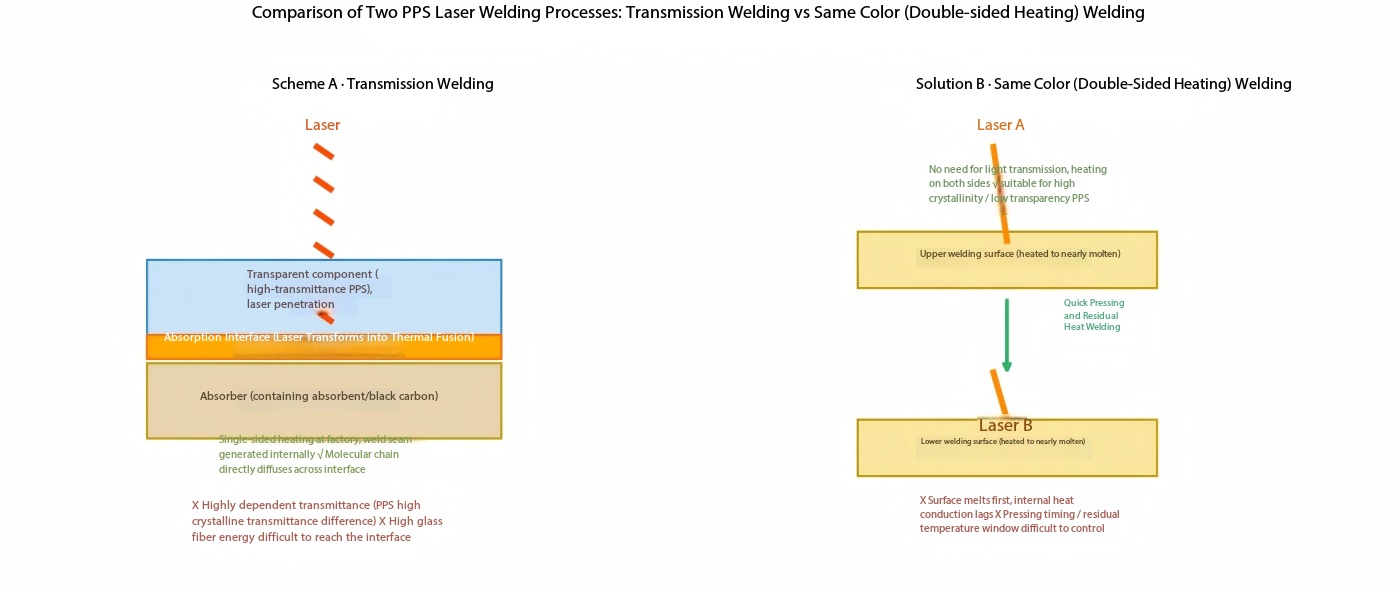
Figure 1: Comparison of the two PPS laser welding processes – Transmissive welding vs. Same-color (double-sided heating) welding
II. Comparison of the Principles of the Two Manufacturing Processes
2.1 Through-welding (Option A)
Principle: A dual-layer structure consisting of a transparent component and an absorbing component is employed. The laser beam penetrates the upper transparent component and is absorbed at the absorption interface (between the absorber and the bottom layer or intermediate layer), where it is converted into thermal energy, causing the PPS material on both sides of the interface to melt. Under pressure, the molecular chains interdiffuse across the interface; upon cooling, this process forms a weld seam.
Core constraints: ① Strong dependence on light transmittance (PPS high-mold temperature injection molding exhibits significant light transmittance degradation due to crystallization); ② When high glass fiber content is present, it becomes difficult for energy to reach the interface; ③ Welds form internally under complex thermal histories.
2.1.1 The temperature-dependent mechanism of PPS secondary crystallization on transmittance
Background phenomenon: During the through-welding process, the transparent layer does not maintain a constant temperature – as the laser continuously penetrates the transparent layer, a portion of the infrared energy is absorbed by the material and converted into heat, causing the temperature of the transparent layer to rise gradually. When the temperature exceeds the glass transition temperature (Tg ≈ 93°C) of PPS, the transmittance decreases sharply, which can subsequently lead to burn defects.
Mechanism Link:
1. The glass transition triggers segmental motion: The Tg of PPS is approximately 85–93°C. Below this temperature, the molecular segments in the amorphous region are "frozen," and the crystallinity remains constant; when the temperature exceeds the Tg, the segmental motion in the amorphous region is activated, and these segments begin to rearrange themselves toward the crystalline region – a process known as secondary crystallization (cold crystallization).
1. Secondary crystallization promotes grain growth: during this process, existing microcrystals serve as nucleation sites for further growth, increasing the thickness of the lamellar grains and expanding their size from the nanometer scale observed in the injection-molded state to larger sizes. Simultaneously, some imperfect crystals undergo melting–recrystallization at higher temperatures, transitioning toward a thermodynamically more stable morphology.
1. The matching of grain size to the light wavelength leads to a dramatic increase in scattering: PPS exhibits an opaque, milky-white translucent appearance due to the difference in its refractive index (n ≈ 1.65) compared to the surrounding amorphous region; at the grain–amorphous interface, Rayleigh scattering and Mie scattering occur. When secondary crystallization increases the grain size to a scale comparable to that of the near-infrared laser wavelength (808–980 nm), the scattering cross-section increases significantly, causing the material to transition from the Rayleigh scattering regime into the Mie scattering regime – where the scattering intensity is no longer proportional to λ⁻⁴ but instead approaches a strong scattering plateau independent of wavelength.
1. Light transmittance decreases sharply with increasing temperature: the aforementioned grain growth effect initiates as the temperature just exceeds Tg and accelerates within the range of 100–150°C. Macroscopically, the light-transmitting layer can still maintain a certain level of light transmittance at room temperature (although this level is relatively low); however, once the welding heating raises the temperature of the light-transmitting layer above 93°C, the light transmittance declines rapidly within tens of seconds, making it increasingly difficult for laser energy to reach the absorption interface.
1. Energy accumulates within the transparent layer → Burn: When the light transmittance decreases, the laser energy can no longer effectively penetrate to the absorption interface; instead, it is scattered and absorbed within the transparent layer, resulting in volumetric energy deposition. As the temperature of the transparent layer continuously rises, local temperatures exceed the thermal decomposition temperature of PPS (>400°C), leading to carbonization and blackening – i.e., a burn. Once a burn occurs, the carbonized region further absorbs the laser energy, creating a positive feedback loop that exacerbates the damage and causes the burn to spread rapidly.
Key temperature nodes:
Temperature range | Crystallization behavior | Light transmittance variation | Welding effect |
<93°C (below Tg) | The amorphous region is frozen; the crystallinity remains unchanged. | Basically stable | Light transmittance supports welding. |
93–150°C (above Tg) | Secondary crystallization initiation; grain growth | sudden drop | The light-transmitting layer begins to transform into an "absorption layer". |
> 150℃ | The grains continue to grow; as they approach the melting point, the degree of crystallinity approaches its maximum value. | Very low | The laser cannot reach the interface, resulting in an extremely high risk of burns. |
The significance of transmissive welding: The aforementioned mechanism reveals an inherent contradiction in transmissive welding of PPS – while the welding process itself requires a transparent layer to maintain sufficient light transmittance for the laser to reach the interface, the welding heating process precisely undermines this prerequisite. The thicker the transparent layer, the higher the laser power, the longer the welding duration, the more severe the temperature rise in the transparent layer, and the more pronounced the attenuation of light transmittance resulting from secondary crystallization. This is also one of the underlying reasons why PPS components with high glass fiber content or high crystallinity are difficult to weld using the transmissive welding method.
2.2 Same-color welding / Double-sided heating welding (Option B)
Principle: A laser is used to independently heat two welding surfaces (the surfaces to be joined on each component); once these surfaces reach a state close to melting, the two workpieces are immediately brought into contact, and the welding is completed by means of the residual heat.
Core advantage: No light transmission required – this solves the light transmittance issues caused by high crystallinity in PPS; particularly suitable for:
● Double-layer fully black surface (no transparent layer – standard near-infrared lasers cannot penetrate it);
● Workpieces with high glass fiber content (extremely low light transmittance);
● High-crystallinity/high-molding temperature injection-molded parts (characterized by coarse grains and strong scattering).
Process steps: ① Heat the upper and lower welding surfaces to near-melting temperature → ② Laser removal → ③ Short dwell time (<1 s) → ④ Immediate bonding → ⑤–⑥ Maintain residual heat → ⑥ Cooling and crystallization curing.
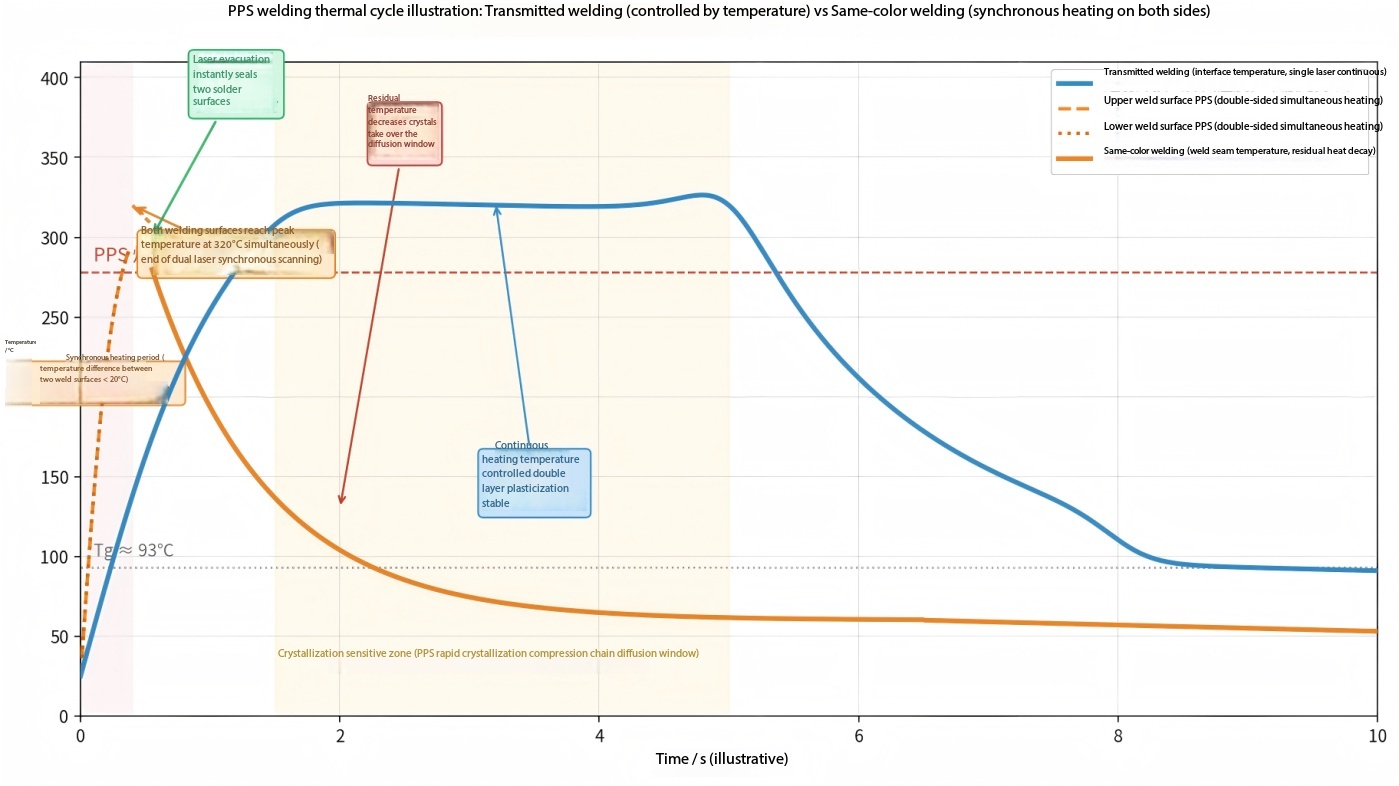
Figure 2: Schematic of PPS welding thermal cycle: Through-welding (blue) vs. Same-color welding (orange)
Figure 2 clearly illustrates the difference in thermal history between the two welding processes: Transmissive welding involves a single, rapid heating phase followed by cooling; in contrast, same-color welding follows a double-peak curve (where both welding surfaces are heated separately), with the molten surfaces overlapping at the moment of bonding, and the weld seam is formed utilizing residual heat.
III. Five Major Risk Mitigation Mechanisms for PPS Welding Using Same-Color (Double-Sided Heating) Method
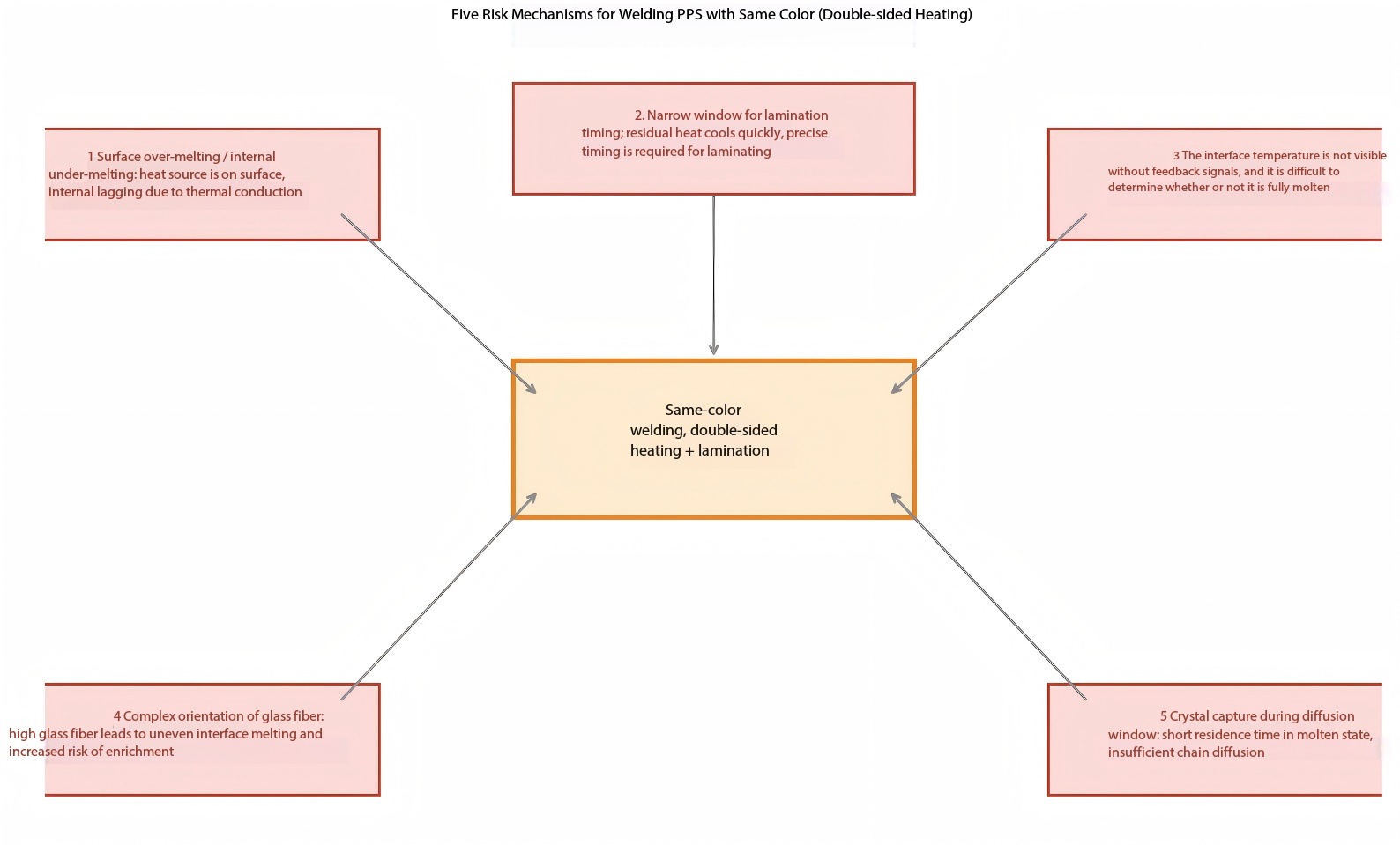
Figure 3: Panoramic illustration of the five major risk mitigation mechanisms for PPS welding with the same color
Risk ①: Surface over-melting / Internal under-melting
Mechanism: The heat source for color-coordinated welding acts on the workpiece surface (the weldable surface of each component), and the heat is transmitted inward through conduction. PPS has a low thermal conductivity (approximately 0.25–0.30 W/m·K), so the internal temperature rise lags behind the surface temperature rise.
consequence :
● Excessively high surface temperature → Resin degradation, coking, or discoloration;
● Insufficient internal temperature → Inadequate melting at the actual weld interface and incomplete chain diffusion;
● During compounding, the surface has undergone partial degradation (reduced viscosity), while the interior has not yet melted – resulting in a surface with a spongy texture.
Comparative through-welding: In through-welding, the heat source is located at the internal interface (absorption layer), and heat diffuses from the interior to the surface, resulting in the most uniform weld temperature distribution. In conventional color welding, however, there is a disparity between the inner and outer regions—the laser heats the surface, while the interior warms up via surface thermal conduction—leading to an uneven temperature distribution between the inner and outer parts. This represents a fundamental flaw based on physical principles.
Risk ②: Extremely narrow pressing timing window
Mechanism: After the two welding surfaces subjected to same-color welding are heated separately, the pressing operation must be completed before the residual temperature has dropped sufficiently low. Once PPS is removed from the heating source, its surface temperature decreases rapidly due to heat conduction and convection.
Window Estimation:
● The surface temperature decreases from 320°C to 250°C (while still in a molten state) over approximately 0.5–1.5s;
● Upon exceeding the Tg temperature (approximately 93°C), rapid crystallization begins, and the weld seam solidifies.
Process complexity: ① Workpiece relocation (from the laser positioning stage to the pressing stage) requires time; ② Mechanical motion delay; ③ Control of surface temperature during dual-sided laser heating. Since all materials are absorbent, the surface temperature rises very rapidly; however, the material has low thermal conductivity while still requiring sufficient residual heat.
Comparative through-beam welding: Through-beam welding involves continuous internal laser heating (during the pressurization phase), providing ample melting time; the bonding process occurs almost simultaneously with the laser heating, thereby eliminating virtually any timing window issue.
Risk ③ Invisible interface temperature (no feedback)
Mechanism: In through-welding, the weld seam is precisely located at the laser heating zone, enabling real-time monitoring of temperature and weld formation status. For same-color welding:
● The laser acts only on the surface → The surface temperature is significant, but the actual internal weld seam temperature is not visible;
● Weld seams are formed only after pressing → Real-time feedback is not possible during weld seam formation;
● Rapid heat dissipation → Once the pressing window is missed, it is difficult to remedy.
Process risks: ① Operators rely on experiential judgment; ② Batch consistency depends on the repeatability of the equipment; ③ There are significant differences in the laser absorption rates of different materials and colored components, as well as distinct residual heat cooling curves.
Comparative through-welding: The interface temperature during through-welding can be monitored in real time using infrared thermal imaging or laser coaxial infrared temperature measurement; closed-loop control is relatively well-established.
Risk ④: Complex high-fiber orientation and non-uniform interface melting
Mechanism: The glass fiber orientation in PPS glass fiber reinforced components (GF30/GF40) is unevenly distributed due to the influence of the shear field and cooling conditions during the injection molding process. When the laser heats the surface:
● Glass fiber has a higher heat capacity than resin (although glass fiber has a lower specific heat capacity, its thermal diffusion is uneven);
● The surface temperature in the glass fiber-enriched zone may be lower than that in the resin-enriched zone;
● The temperature in the «shadow zone» surrounding the fiberglass exhibits thermal lag.
consequence :
● Uneven melting at the weld interface; localized poor welding or localized over-melting;
● The enrichment risk at the glass fiber orientation interface increases (as glass fibers accumulate along the direction of melt flow);
● After the resin near the fiberglass is extruded, the fiberglass rises to the surface, increasing the surface roughness.
Comparative through-transmission welding: The effect of fiberglass in through-transmission welding primarily concerns light transmittance (preventing laser light from reaching the interface); however, since the weld seam is located internally and the fiberglass is encapsulated by the molten material, the floating fiber issue is relatively less severe.
Risk ⑤ Crystal formation monopolizes the molecular chain diffusion window
Mechanism: PPS exhibits an extremely high crystallization rate (1–2 orders of magnitude faster than PA12). In color-matched welding:
● Rapid cooling of the molten material after compression;
● The crystallization induction period is extremely short (the most intense phase occurs between the melting point and 200°C);
● Once crystallization occurs, the molecular chain motion is frozen, and interfacial mutual diffusion is terminated.
Triple Occupation:
① Short molten-state dwell time (transmission welding follows a "pressure holding – continuous heating" sequence; same-color welding follows a "compression – residual heat dissipation" sequence);
② Mechanical disturbances during the bonding process may introduce interfacial bubbles;
③ The residual temperature drops rapidly, allowing crystallization to be completed faster than the diffusion of molecular chains.
Consequence: Insufficient entanglement → Weld joint strength lower than that of the base material → Susceptible to failure under loading or cyclic pressure conditions.
Comparative through-transmission welding: The combination of pressure holding and continuous heating provides sufficient time and temperature for molecular chain diffusion.
IV. Deepening understanding from a polymer physics perspective
4.1 Similar weld seam nature: mutual diffusion and entanglement of molecular chains
The weld seams of both processes essentially constitute interfacial molecular chain cross-linked entanglement networks; the entanglement density determines the weld seam strength. The difference lies in:
● Through-welding: Heat is continuously supplied from within, allowing the molten metal sufficient time to diffuse under pressure;
● Same-color welding: Heat acts briefly on the surface; after pressing, it spreads via residual heat – a short time window;
The final step for both processes is crystallization and curing; however, the constraint associated with rapid crystallization of PPS also applies.
4.2 Decoupling of light transmittance from weld joint strength
The PPS light transmittance issue is a surface phenomenon (optical scattering), whereas the weld strength problem stems from an internal structural issue (chain entanglement). Homochromatic welding circumvents the optical issue by "not relying on light transmission," but at the cost of:
● The heating source location is moved from "Internal" to "Surface," completely altering the thermal history;
● Process control has shifted from "real-time monitoring" to "precise timing," resulting in a significant decrease in control accuracy;
● The ultimate strength of welds is typically lower than that of through-welded components.
4.3 Comparison with traditional thermal conduction welding
In terms of principle, same-color welding shares similarities with traditional hot-plate or hot-air welding (Hot Plate Welding): in both cases, the workpiece surface is first heated before being joined. The difference lies in:
● Hot plate welding: The heat source is macroscopic hot-plate heat transferred via thermal conduction; the maximum temperature is limited to the temperature of the hot plate or the hot gas; the temperature distribution is uniform, but the contact area is large;
● Same-color welding: The heat source is a laser (point/line scanning); the surface temperature is not controllable, with localized high temperatures that can lead to material degradation;
Both approaches face the challenges of "soldering timing" and the "residual heat window," but laser-based product transformation offers greater flexibility. However, the inability to precisely control the temperature during the product soldering process poses a significant challenge regarding both the batch yield rate and the robustness of mass production – an aspect that warrants careful consideration.
V. Maximum Strength Comparison and Quantitative Analysis
The influence of the two manufacturing processes on the ultimate tensile strength of welds:
● Through-transmission welding: Theoretical achievable coverage of the base metal ranges from 80–95% (affected by glass fiber enrichment and chain diffusion);
● Same-color welding: Theoretical achievable coverage of the base material is 60–80% (affected by the residual heat window and surface degradation);
● Maximum strength difference: Same-color welding typically exhibits a 10–20 percentage point lower strength than through-welding.
Ranking of core factors affecting ultimate strength:
1. Entanglement density (chain diffusion time): Transmittance> Same color;
2. Fiberglass enrichment degree: Transmittance = Same color (both are affected by this);
3. Surface degradation (only applies to the same color): The risk is higher for the same color;
4. Interface bubbles (only present for the same color): The risk associated with this color is higher;
VI. Process Selection Recommendations
Select the appropriate manufacturing process based on the workpiece characteristics:
● Transparent components + low/medium glass fiber: Preferential through-welding (high strength, excellent stability);
● Fully black components / High-grade fiberglass (GF30+): Preferential same-color welding (transmission welding is no longer feasible);
● High-temperature operating environments (>200°C): Preferential through-welding (large strength margin);
● Complex irregular-shaped parts / large-area welding: Same-color welding or hot-plate welding is more suitable.
Key points for process optimization in PPS color-coordinated welding:
● Laser power + scanning speed: Identify the optimal operating range where the surface is fully melted without undergoing degradation;
● Heating sequence: First heat the thick-walled/high-rigidity surfaces, then the thin-walled surfaces, ensuring that the temperatures on both sides are matched during bonding;
● Bonding timing: From laser cessation to completion of bonding – <1s;
● Compression pressure: Moderate (to prevent ejection of molten material); hold pressure for 1–3s;
● Post-welding annealing: 150–180°C for 2–4 h; this process restores crystallinity and eliminates internal stresses.
VII. Conclusion
Same-color (double-sided heating) welding represents a viable alternative for high-crystallinity, low-transmittance materials such as PPS; it circumvents the transmittance limitations associated with transmission welding, albeit at the cost of a narrower process window and increased risks.
The five major risk mechanisms—surface over-melting/internal under-melting, narrow pressing timing window, invisible interface temperature, complex glass fiber interfaces, and crystallization preemptive diffusion—are essentially the inevitable outcome of the physical combination of "the heating source being located on the surface" and "rapid crystallization of PPS."
Process selection recommendation: For workpieces suitable for through-welding, through-welding should be preferred; for workpieces not suitable for through-welding, the process parameters for same-color welding must be strictly controlled, and the weld joint quality must be verified through methods such as destructive testing or microscopic sectioning.
Technical Note: In the PPS welding field, process selection is not about which method is "better," but rather about which method best matches the material properties and part geometry. Understanding the underlying principles is essential for making informed decisions when working with specific workpieces.
-End of document-
 Home
Home Products
 Telephone
 Message


